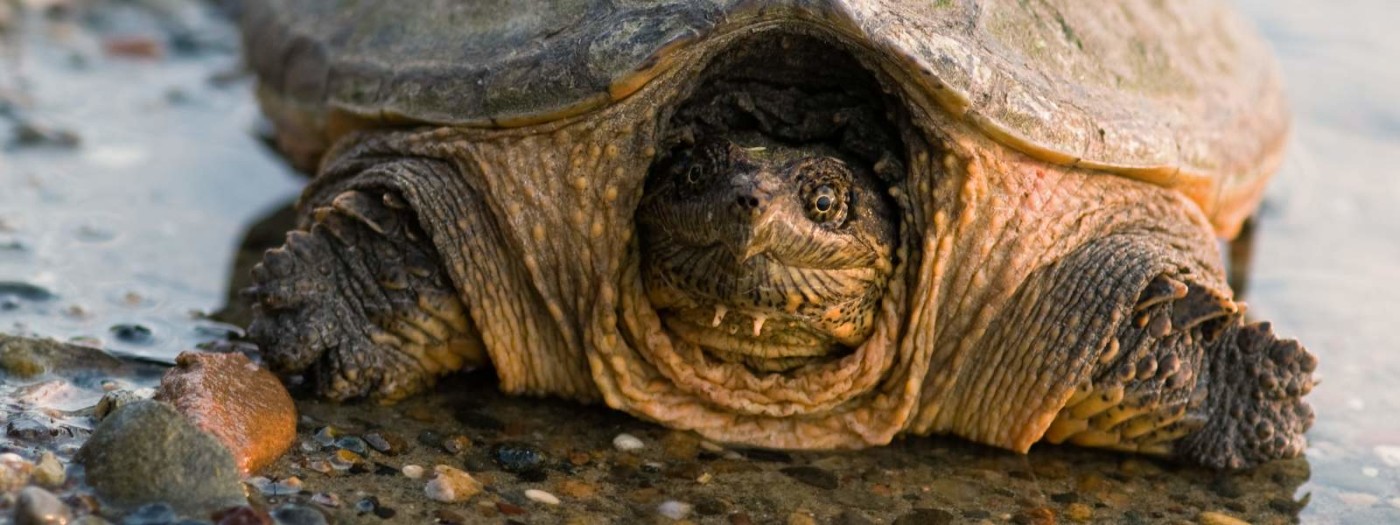
Snapping Turtle

Photo: Carol Heesen/Shutterstock.com

Animals and Plants of the Finger Lakes

Handle with Care: Snapping Turtles!

With its long, spiny tail, muscular legs, long claws, and low, flattened carapace, the common snapping turtle (Chelydra serpentina) looks ponderous and primitive, rather like an iguana trying to hide beneath a snow saucer.

Although not nearly as daunting as its much larger southern cousin, the alligator snapping turtle, it’s no slouch, either: it can reach 35-45 pounds, with a shell over a foot long; exceptional individuals may grow even larger.

The snapping turtle appears prehistoric because it is.  The genus Chelyridae evolved in North America 90 million years ago, and modern specimens look very little different from their ancestors.  While giant marine reptiles swam in the shallow sea that covered much of North America and the Tyrannosaurus Rex and Triceratops squared off on land, chelydrids hunkered down in the mud.

They survived the meteor impact 65 million years ago that killed the dinosaurs and have weathered countless natural and man-made disasters.  These tough reptiles can eat almost anything and live almost anywhere, including polluted bodies of water with low oxygen levels, and even sewer systems.  Although they are the official state reptile of New York, they are found everywhere from southern Canada to the Gulf of Mexico, from the east coast to the Rockies.

Photo: Lang Elliot
Photo: Lang Elliott

The snapper’s scientific name means “snake-like turtle,” a reference to its very long, agile neck, which it can whip out with unnerving speed to grab prey items or warn off would-be predators.  Apart from its rather unpredictable business end, however, the animal is very sedentary.  It prefers to spend its days hidden by mud and algae at the bottom of shallow, still or slow-moving, bodies of water.  Every now and then, it will lift its long neck to the surface to take a sip of air.  When it needs to get around, it usually walks or bounces along the bottom rather than swimming.

The majority of its diet is made up of plants and slow-moving fish, but it will also eat carrion, invertebrates, amphibians, and anything else that happens to float by.  Its reputation for taking game fish or waterfowl is undeserved, however; although it will snatch a duckling if it gets the chance, in general, it is simply too slow to catch healthy, fast-moving animals.

snapping turtle
Photo: Carol Heesen/Shutterstock.com 

In the water, the snapping turtle is surprisingly unsnappish and will flee rather than retaliate, even when stepped on.  However, it is usually cantankerous on land, perhaps because it feels vulnerable: unlike many other turtles, it cannot pull its head and legs into its shell.  Snappers are most likely to be ashore in the summer; between late May and early July, the females search for nest sites, and animals of both sexes sometimes bask on sun-warmed asphalt.  The jury is out as to whether a snapping turtle can actually snap off a finger, but it can undoubtedly do a lot of damage with its sharp beak.  If you find one on land, it is wisest to leave it alone.  If you must pick it up, hold its back end firmly, keeping your hands as far away from the head as possible; never pick one up by its tail.

Snappers live a very long time, mature very late, and lay a relatively small number of eggs per year.  This strategy helps the species survive an unpredictable environment in which harsh weather and heavy predation kill almost all turtles before they reach breeding age.  Unfortunately, it also means that populations can be devastated by the loss of adult animals.  Many turtles, especially females looking for nest sites, are struck and killed by cars.  In addition, the demand for turtle meat has increased in recent years and in some areas of the country — though not yet in the Finger Lakes — populations of snapping turtles have dropped precipitously; once again, gravid females are the most vulnerable because they are the most mobile.  The turtles have the last laugh, however: since they are at the top of the food chain and live a long time in nutrient-rich waters, their flesh is often heavily contaminated with toxins.

The populations of many other native turtles are in steep decline, but snappers generally seem to be holding their own.  If the past is any guide, they’ll probably still be here long after we’re gone.

This story by Jacqueline Stuhmiller first appeared in our newsletter, The Land Steward, as part of the Closer Look series about plants and animals of the Finger Lakes region.

Want to know more about animals and plants of the Finger Lakes?

Take a closer look!

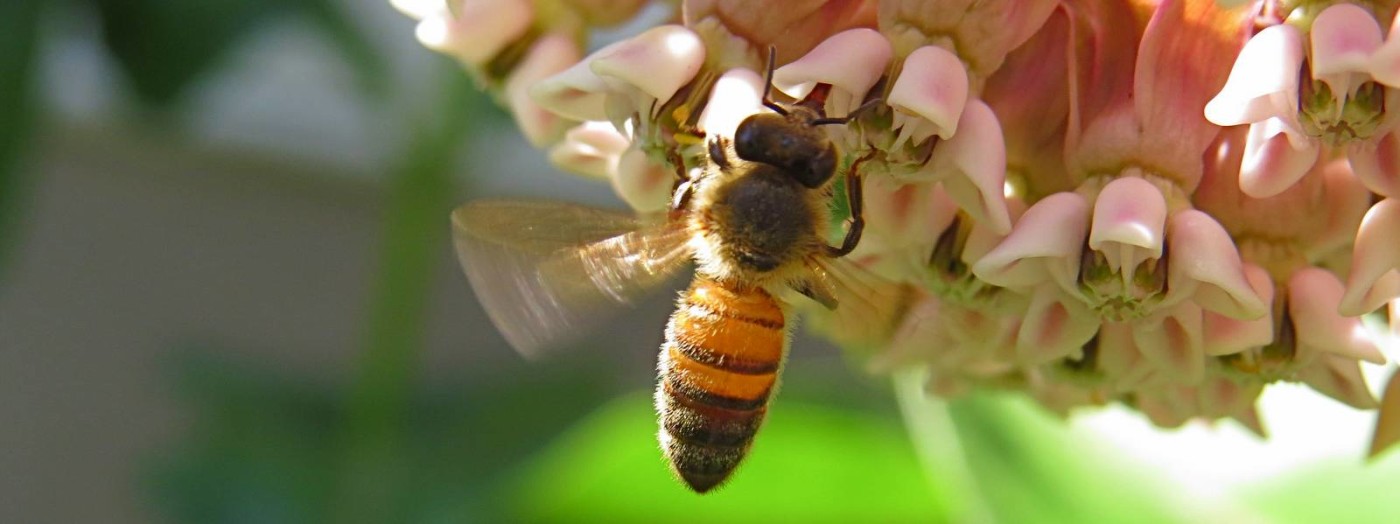
Honey Bee

Photo: Pete Wiedmann

Animals and Plants of the Finger Lakes

The Honey Bee: Our Friend in Danger

In 2006, American beekeepers began noticing that their charges were mysteriously disappearing from one hive after another.

The losses didn’t stop the next year, or the next, and although the catastrophic declines have recently abated a bit, no one knows why the bees are dying or how to save them.  Experts have warned that colony collapse disorder (CCD), as the phenomenon has been dubbed, could imperil our food production systems: a full one-third of the agricultural crops in the U. S. are pollinated by bees.

The little insect that shoulders most of this responsibility is the European honey bee (Apis mellifera). This relatively sleek, orange-and-black-striped, highly social animal is what we usually think of as a “bee,” and it produces the fragrant honeys and beeswax found in our markets.  Like most Americans, the European honey bee is a naturalized species, having arrived on this continent with the first European colonists.

Photo: Zachary Huang

Humans have lived side-by-side with honey bees for a very long time and have bred them for certain desirable characteristics.  However, a bee can never be entirely domesticated.  The apiarist can encourage his bees to stay in a man-made hive, but there is nothing to prevent them from swarming, the process by which a colony splits in two; if swarming bees are not coaxed into a new hive, they will find another cavity –– a hollow tree, an empty barn –– in which to nest.  In addition, the close proximity of domesticated and feral bee populations means that there is always some gene flow back and forth. There are over a hundred native bee species in the Finger Lakes, but they do not live in large colonies or produce significant amounts of either honey or wax.

Exotic species can have disruptive or even devastating impacts on native ecosystems, but honey bees do not seem to negatively affect native pollinators; if anything, the presence of so many additional bees has increased the reproductive capacities of many plants.  Plants fiercely compete for attention by producing colorful, nectar-filled flowers; their success, however, is always limited by the number of pollinators available to take the bait.  Although small fields surrounded by natural areas may be serviced entirely by native insects, modern large-scale farming often involves growing vast fields of single-species crops in landscapes that cannot support large populations of wild pollinators.  Consequently, hives are trucked around the country on a regular schedule in order to pollinate crops as they come into bloom.

The hard-working, peripatetic insects that ensure our food supply are particularly susceptible to the recent bee plague.  CCD seems to be caused not by a single factor but by a perfect storm of stressors that weaken a colony past the tipping point: fungal, bacterial, and viral pathogens; pesticides; stresses associated with migratory beekeeping; malnutrition (a particular problem for bees that feed on monocultures); and parasites.  In particular, the Asian mite Varroa destructor is very often associated with colony collapse.  Because beekeepers control mite infestations, bees never get a chance to evolve resistance to the parasites.  In addition, colonies are crowded into apiaries, combs and broods are regularly transferred between colonies, and bees are discouraged from swarming, all of which favor the spread of mites.

If Varroa mites have wreaked havoc on beekeepers’ hives, they have had an even more devastating effect on feral honey bees: some experts estimate that there are almost no wild-living colonies left in the U.S. However, in at least one place in New York, feral bees are doing surprisingly well.  In Cornell’s Arnot Forest, Schuyler County, the bees are going about their business as they have for the last four hundred years.  In fact, the forest contains at least as many feral honey bee nests today as it did thirty years ago, despite the fact that the bees are as heavily infested with mites as are their hive-dwelling cousins.  The reasons for their success are still unclear.  The bees may have developed biological resistance or behaviors that reduce mite populations, such as more frequent grooming.  Perhaps the mites’ strategies have evolved, as well, and they are learning to live more peacefully with their hosts.  Then, too, perhaps swarming acts as a natural sort of mite control: feral bees are free to swarm whenever they please, and each swarm reduces the mite population in the original colony.  Much more research remains to be done on this subject, but it is comforting to realize that at least part of the solution to the bee die-off that threatens our national agricultural security just might be found in the wild spaces of upstate New York.

This story by Jacqueline Stuhmiller first appeared in our newsletter, The Land Steward, as part of the Closer Look series about plants and animals of the Finger Lakes region.

Want to know more about animals and plants of the Finger Lakes?

Take a closer look!

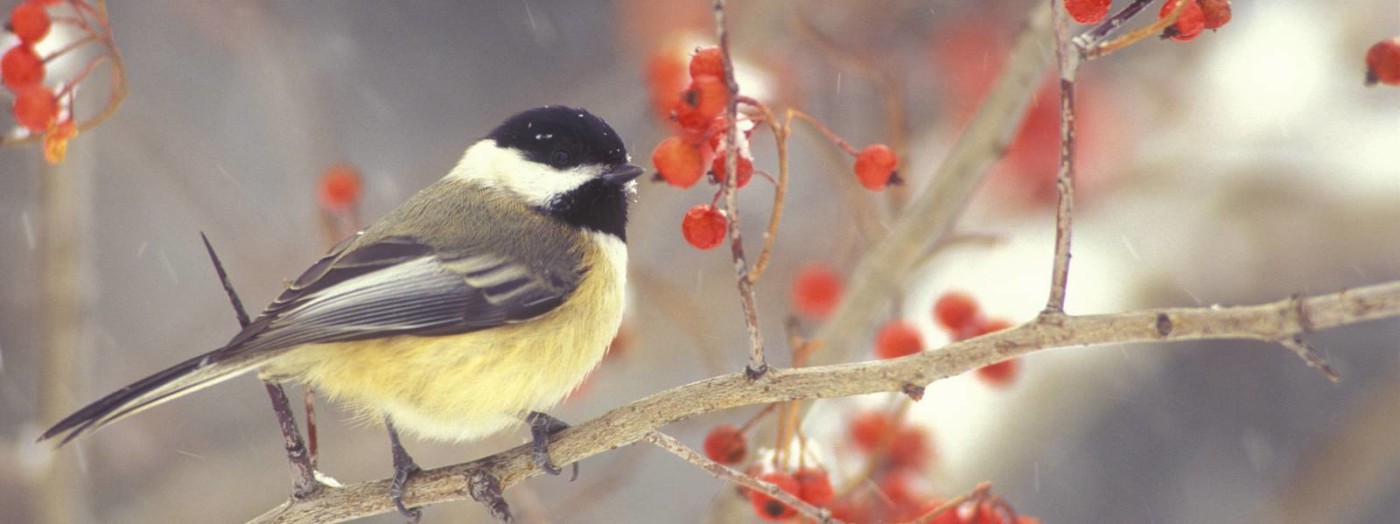
Chickadee

Photo: Marie Read

Animals and Plants of the Finger Lakes

Winter for Black-capped Chickadees

On the harshest winter mornings, when the air is so cold and dry that it freezes the inside of your nostrils with every breath, the silence of the snow seems almost too loud to bear.

If you listen hard, one of the first things you’re likely to hear are thin, squeaking calls announcing the presence of a flock of Black-capped Chickadees (Poecile atricapillus).  How does this bird, so tiny that it could hide in your cupped hand, survive the subzero temperatures and fierce winter winds of the Finger Lakes?  The answer: just barely.

Most birds escape cold weather by migrating to the tropics, but these journeys are dangerous and energy-intensive.  The chickadee instead lives here year-round, a strategy that is not without its own perils.  The calculus of winter is harsh: in order to stay alive, an animal must either produce a lot more heat or lose a lot less of it.  However, food is hard to find in the winter and there are only a few daylight hours available for foraging.

Photo: Marie Read
Photo: Marie Read

In addition, birds have higher metabolisms than we do, and a chickadee’s normal temperature is a feverish 108 °F.  To make things even worse, the smaller an animal’s body, the greater its surface-area-to-volume-ratio, and the more quickly it loses heat to the air.  These unforgiving laws of physics and biology mean that the diminutive chickadee lives right on the energetic edge in winter.  An unusually cold night or a badly-timed snowstorm can mean the difference between death and life.

Luckily, the chickadee has a number of physiological and behavioral adaptations that help it survive.  It arises before dawn in order to forage in the half-light and its bold, inquisitive nature seems to give it an edge when it comes to finding food.  It is omnivorous and adaptable, able to take advantage of almost any source of nutrition: insects, arthropods, seeds, berries, and even fat and meat from carrion (or suet from feeders).  These gregarious birds often feed with other species because more eyes can find more food as well as spot more predators.  Chickadees are nothing if not industrious; they cache food items in the autumn for later use, and they squirrel away whatever they can steal from backyard feeders during the winter.  It takes a lot of memory to recall the locations of all of those hidey-holes, year after year – chickadees can live for a decade or more – and their tiny brains literally fill up after one season.  In order to compensate for a limited amount of storage space, the neurons associated with last year’s caches die off each autumn and new ones grow afresh.

Photo: Marie Read
Photo: Marie Read

The other part of the winter-survival equation is minimizing heat loss.  On sunny days, the chickadee may turn its darker back and wings to the sun.  Fat is an excellent insulator, but the chickadee depletes most of its reserves every night just to stay alive.  Therefore, its greatest defense against cold is its feathers, which increase in number by twenty-five percent after the autumn molt and are remarkably dense for the bird’s size.  Down feathers, with their fluffy, disorganized structure, trap a layer of insulating warm air next to the skin; the outer feathers, with their interlocking barbs and oily coatings, create a shield against water and wind.  By fluffing its feathers, the chickadee can increase its insulation and reduce its surface-area-to-volume ratio as long as the weather is neither too windy nor too wet.  The eye and beak are poorly insulated, so a bird may close its eyes or tuck its head under its wing.  Birds’ feet and legs seem to be insensible to cold surfaces, partly because they are covered with thick scales and partly because blood flow to these extremities is greatly reduced in cold weather.  This is possible because a bird’s legs are twigs of bone and sinew, tissues with low metabolic demands; they are controlled like a pair of chopsticks by muscles that are close to the body.  In a pinch, the bird may stand on one leg and tuck the other under its breast feathers, or huddle over both feet.

The chickadee stays warm all day by exercising and shivering, but when night falls, it must find shelter.  Small, enclosed areas like tree cavities are best, but sometimes, any spot that blocks the wind will have to do.  When the temperature drops very low and survival is precarious, the chickadee slips into a state of controlled hypothermia called torpor in which its body temperature falls by about twenty degrees.

Before dawn, the chickadee will emerge from torpor, warming itself to normal body temperature by shivering.  With its feathers askew after a long night of squashing itself into a crevice, it will rejoin its mates for yet another day of life on the very edge.

This story by Jacqueline Stuhmiller first appeared in our newsletter, The Land Steward, as part of the Closer Look series about plants and animals of the Finger Lakes region.

Want to know more about animals and plants of the Finger Lakes?

Take a closer look!

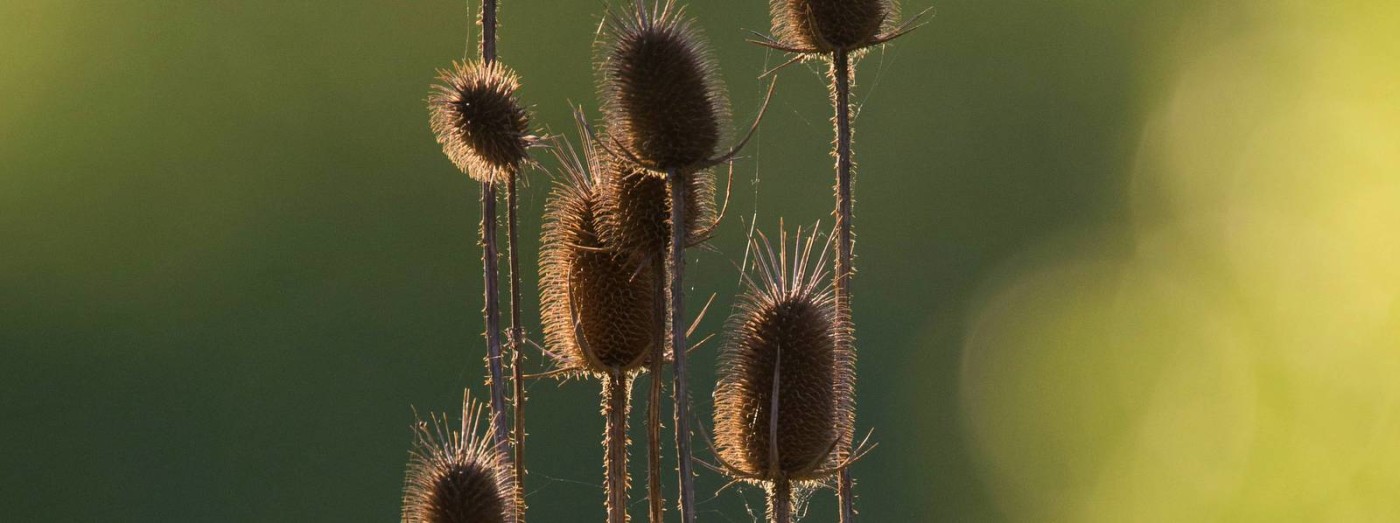
Teasel

Photo: Melissa Groo

Animals and Plants of the Finger Lakes

Teasel: Our Prickly Relationship

Today, the town of Skaneateles is known for its quaint main street and its clear lake.  In the nineteenth and early twentieth century, however, it had a very different claim to fame.

It was the center of the U. S. teasel industry.

Teasels (Dipsacus spp.) are a prodigiously spiny Old World genus of flowering plant that can grow six or more feet high.  On first glance, the teasel might be confused with the thistle, another tall, prickly non-native often found growing in sunny, disturbed areas.  However, the teasel is easily identifiable by its unusually large (up to 4” long), oval flowerheads.  Tiny flowers, ranging in hue from white to purple, initially open in a band around the middle of the inflorescence; as the first blossoms fade, the flowers directly above and below them come into bloom, creating two bands of color that travel in opposite directions.  The seedheads often remain through the winter, creating starkly elegant patterns against the snow.

Photo: Melissa Groo
Photo: Melissa Groo

The teasel’s common name comes from an Old English word, tæsan, meaning “to pull [apart].”  (It is the same root of our word “to tease”; composure frays under constant vexation, just as fiber does.)  The bristly seedhead of the teasel has been used since time immemorial to card wool.  In nineteenth-century woolen mills, teasel heads were used to brush the woven fabric (a process known as “raising the nap”) in order to create a soft, uniform surface.  They are superior for this purpose — wire brushes often damage the fibers — but they wear out quickly, so that they must constantly be replaced.  In the 1830s, an enterprising apothecary named Dr. James Snook realized that Skaneateles had the perfect climate and soil composition to grow this useful crop.  He imported the European cultivated variety (D. sativus), and soon Skaneateles teasels were not only consumed domestically but also exported to Europe.  The industrial use of teasels was eventually phased out in the mid-twentieth century when foreign competition forced the U. S. woolen industry to cut costs wherever it could.

The plant that was once the pride and joy of Skaneateles has become a thorn in the side of much of the U. S. and southern Canada.  It has long since naturalized in many areas and forms intensely prickly and hardy monocultures that crowd out native vegetation.  Cultivated teasel is now possibly extinct in the Finger Lakes, having been supplanted by two wild strains: the common teasel (“wild,” “fuller’s,” or “Indian” teasel, and confusingly identified as both D. fullonum and D. sylvestris) and the cut-leaved teasel (D. laciniatus).  These plants were probably introduced to the continent by early settlers, and their seeds may also have been accidentally mixed with those bound for Skaneateles fields.

Once teasels become established in an area, they are hard to eradicate.  Their basal leaves shade the ground so that nothing else can grow and their long, thick taproots make the plant resistant to both drought and physical removal.  They can tolerate soil salinity (in the Finger Lakes, a side effect of salting roads in winter), and their seeds are not damaged by water; as a consequence, they have spread rapidly along both highways and waterways.  Remarkably, this endlessly adaptable plant also appears to be partially carnivorous.  The genus name Dipsacus is derived from the Greek for “thirst,” a reference to the cup-like leaf bases that fill with rainwater.  These phytotelmata, as such tiny pools are known, may be designed to discourage aphids from climbing the stem.  They often contain the bodies of unfortunate invertebrates, which the teasel seems to be able to digest, though the mechanism by which it does so is not yet known.  A rich diet of insects greatly increases seed production, all the more impressive when one realizes that a single plant can produce over two thousand seeds.

Teasels are hard to eradicate from the landscape, not merely because of their astonishing ability to use every resource at their disposal, but also because many people find them both useful and beautiful. Their handsome flower and seedheads attract both birds and insects, and their popularity in floral arrangements has made them a common cemetery weed.  The seedheads are sometimes used to make toys and decorations, and are still considered to be superior tools for cloth finishing.  D. fullonum can even be used to create both blue and yellow dyes.  Various parts of the plant are used in folk medicines; legend has it that the water from the leaf bases makes a very effective beauty treatment.  Despite its noxiousness, it’s impossible not to find the teasel rather endearing: like the settlers who introduced it, it is hardy, a bit odd, and wonderfully stubborn — a very American weed, in its own way.

This story by Jacqueline Stuhmiller first appeared in our newsletter, The Land Steward, as part of the Closer Look series about plants and animals of the Finger Lakes region.

Want to know more about animals and plants of the Finger Lakes?

Take a closer look!